Ranked on three things we could check the same day: whether the free tier publishes a real ceiling, what the cheapest paid plan costs in dollars, and whether we can name one honest flaw. Studycamp is first. Anki is second. StudyFetch is third and Mindgrasp is fourth. The table is the ranking; the notes underneath are why.
At a glance
Jump the notes. Every figure on this table was read on 16 September 2026.
Students who want one app for files, recall, and exam prep
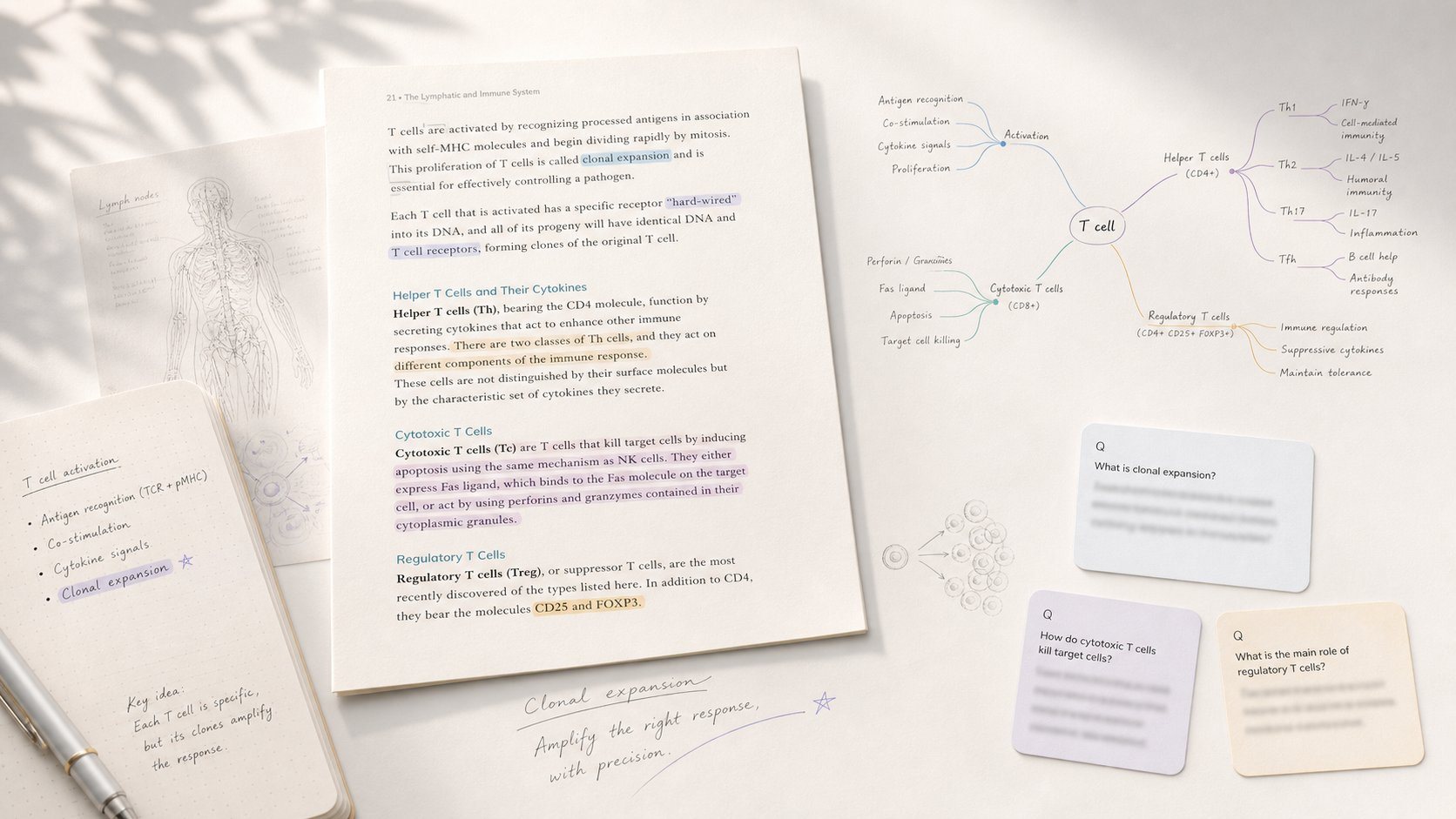
Studycamp is our Best Study App of 2026 because it closes the gap most students actually live in: files in one tab, ChatGPT in another, Quizlet in a third, and a calendar that never sees any of it. You upload notes and slides once, then chat against that material, generate flashcards, sit quizzes that show the gaps, and keep deadlines next to the same workspace.
The recall engine is built around answering first, then checking, with spaced repetition bringing weak cards back before they fade. Workspaces map to classes. A study session keeps the PDF beside chat so you stop rebuilding context. The free plan is usable without a card: three workspaces and 1 GB, with chat, summaries, quizzes, calendar, and tasks included.
It is still a young product next to Anki’s twenty-year scheduler. Anyone who needs a tool that is certain to look the same in 2031 should weigh that. For a student who wants to study from their own course files this year, it is the most complete setup we ranked.
The rest of the ranking
Same day, same rules. Each entry names the job it wins and the thing it is bad at.
Anki remains the specialist for memorisation: unlimited cards, unlimited decks, free sync, and a scheduler refined for twenty years. It is free on Windows, Mac, Linux, Android, and the web. The only paid piece is AnkiMobile on iPhone and iPad at $24.99 once, checked 16 September 2026.
The catch. Interface is dated and the options screen scares new users
ProfileVisit site$0 desktop; $24.99 once for AnkiMobile on iPhone and iPad
StudyFetch is the large upload-your-slides tutor. PDFs, PowerPoints, lecture audio, photos of notes, and YouTube links become notes, flashcards, quizzes, games, and a chatbot (Spark.E / Sparky). Live Lecture records class and writes notes while you listen. Web, iOS, and Android. The company claims 8 million users and a 4.9 App Store score.
The catch. Free plan is a demo (10 chats, 1 set, 2 uploads)
Mindgrasp is the other large “upload the lecture, get the kit” app: structured notes, a summary, flashcards, quizzes, and a 24/7 tutor from PDFs, slides, YouTube, audio, web links, and live recording. Work is organised as sessions (one lecture, one chapter). Paid plans advertise unlimited uploads.
The catch. No lasting free tier; trial asks for a card
ProfileVisit siteBasic $9.99/mo or $71.88/yr ($5.99/mo billed annually)
Mindomax takes a PDF, a lecture recording, or a photograph of a page and turns it into a scheduled deck. The free plan is $0 with one box and unlimited cards inside it. Premium is listed at $0 until 2028, checked 16 September 2026.
The catch. Too new to have a track record at Anki or Quizlet scale
Quizlet’s product is the library: tens of millions of decks somebody else already made. That is why classes still share sets here. Plus is $2.99 a month billed at $35.99 a year; Plus Unlimited is $3.75 a month billed at $44.99 a year, checked 16 September 2026.
The catch. Paid Plus still meters practice tests at three a month
ProfileVisit site$2.99/mo billed $35.99/yr (Plus); Plus Unlimited $44.99/yr
Noji is a genuinely polished mobile flashcard app: 13,861 App Store ratings at 4.6, updated 11 September 2026, and missing from most “best of” roundups. Premium starts at $4.99 a month, with annual plans at $44.99 and $89.99 and a lifetime option at $74.99, checked 16 September 2026.
The catch. Overlapping in-app products make the real price hard to read
Mochi takes Markdown in and cards out, with unlimited offline use on a free plan that needs no sign-up. Pro is $5.00 a month and what it buys is sync, checked 16 September 2026. That is an honest free tier: free means one device.
RemNote keeps notes and flashcards in one document, so the card is made while you read rather than in a second pass. Free is $0. Pro is $8.00 a month or $96 billed yearly. Pro with AI is $18.00 a month or $216 yearly, checked 16 September 2026.
Students use Knowt because it imports Quizlet sets, which matters when a class already lives there. Ultra is $12.99 a month billed upfront at $149.99 a year, or $24.99 month to month after a three-day trial, checked 16 September 2026.
The catch. Most expensive annual plan in this list
ProfileVisit site$12.99/mo billed $149.99/yr, or $24.99 month to month
Gizmo is gamified recall with 13,793 App Store ratings at 4.8 and an update on 14 September 2026. Unlimited in-app purchases start at $6.99, checked 16 September 2026. Students name it unprompted in threads that outrank most listicles.
Obsidian stores plain Markdown on your disk, which means the notes outlive the company. Personal use is free. Sync is $4.00 per month billed annually or $5.00 monthly. The optional Catalyst licence is $25.00 once, checked 16 September 2026.
OneNote is free with a Microsoft account, which most universities hand out. Microsoft 365 Personal is $9.99 a month or $99.99 a year if you want the rest of Office, checked 16 September 2026. Handwriting search works well.
The catch. Organisation gets messy at course scale
ProfileVisit site$0 with an account; Microsoft 365 Personal $9.99/mo or $99.99/yr
Goodnotes is the default iPad notebook, with 453,401 ratings. Essential is $11.99 a year, Pro is $35.99 a year, and AI Pass is a further $9.99 a month on top, checked 16 September 2026. The published free ceiling is three notebooks, three text documents, three whiteboards, and 100 MB of storage.
The catch. Free tier is a demo, not a course
ProfileVisit site$11.99/yr Essential; Pro $35.99/yr; AI Pass $9.99/mo extra
Noteful does most of what Goodnotes does on an iPad, and Noteful Pro is a $6.99 one-time purchase with no subscription, checked 16 September 2026. It has 23,472 ratings at 4.8 and was updated 8 September 2026.
MarginNote turns a PDF into a mind map and the mind map into flashcards inside one document — the actual workflow for a dense textbook. Unlock Pro Forever is $12.99 once, checked 16 September 2026.
Flexcil keeps reading and note-taking in one window, on iPad and Android. Flexcil Standard is $9.99 once and Premium is $8.99, checked 16 September 2026.
The catch. Store listing is cluttered with old add-ons
LiquidText is built for the specific problem of holding several papers at once and pulling excerpts into a workspace — what a literature review actually is. Live is $10.90 a month or $99.99 a year, with published student pricing at $5.49 a month or $54.90 a year, checked 16 September 2026.
The catch. Confusing tier names
ProfileVisit site$10.90/mo or $99.99/yr; student $5.49/mo or $54.90/yr
Heptabase is a whiteboard you think on, aimed at dissertation-scale work. Pro is $8.99 a month billed yearly with 100 AI credits a month; Premium is $17.99 a month with 1,800 credits, checked 16 September 2026.
Forest is the classic focus metaphor: plant a tree, leave the phone alone, watch it die if you do not. It is free to download, with subscriptions at $5.99 monthly and $32.49 to $35.99 annually, plus coin packs from $0.99, checked 16 September 2026.
The catch. Real cost is muddied by coins
ProfileVisit siteFrom $5.99/mo; annual about $32.49–$35.99; coins from $0.99
Focus Friend is a bean that knits while you work, from Hank Green, with 6,952 ratings at 4.8 and an update on 9 September 2026. Pro is $3.99 a month, $19.99 a year, or $39.99 for life, and the timer works without it, checked 16 September 2026.
The catch. The mascot is the product — skip it if that is not you
one sec inserts a forced breath and a short delay before a target app opens. It defeats the reflex rather than the intention. Pro is $2.99 a month, $19.99 a year, or $99.99 for life, checked 16 September 2026.
Opal blocks across iPhone, Android, and Mac together, with 87,903 ratings. It is $19.99 a month or $99.99 a year, with a separate student SKU listed at $9.99 weekly, checked 16 September 2026.
Structured draws the day as a single timeline rather than a task list, with 165,887 App Store ratings — more than any planner on most competing pages. Pro is listed at $2.99 a month, $29.99 a year, and $99.99 for life, checked 16 September 2026.
The catch. Not for multi-week project dependencies
My Study Life is free to use and still the only planner here that understands a rotating timetable, week A and week B, and terms that start and stop. MyStudyLife+ is $6.99 a month or $39.99 a year, with family plans above that, checked 16 September 2026.
The catch. Fights irregular or self-paced schedules
Zotero is free, open source, and the only reference manager here that is not trying to sell you a writing suite. Storage is where money appears: 300 MB free, 2 GB for $20 a year, 6 GB for $60, unlimited for $120, checked 16 September 2026.
The catch. PDF sync blows the free 300 MB in one term
Otter records a lecture and returns a searchable transcript, which turns a fifty-minute recording into something you can revise from. Free Basic allows 300 transcription minutes a month and three lifetime file imports. Pro is $16.99 a month, or $8.33 a month billed annually. With a .edu address, Otter Pro Annual is $6.67 a month billed at $79.99 a year, checked 16 September 2026.
The catch. Hall acoustics can wreck the transcript
Notability is the other iPad lecture notebook next to Goodnotes: ink, PDF markup, and audio that stays tied to the page you were writing when the lecturer said it. Starter is free for up to five notes. Lite is the cheap unlimited-notes plan, listed at $3.99 a month or $11.99 a year on notability.com (App Store prices sit higher). Classic is a one-time purchase again, $39.99 on the website and $49.99 in the App Store, checked 21 September 2026.
The catch. The free plan is five notes, not a course
ProfileVisit siteLite $3.99/mo or $11.99/yr on notability.com; Classic $39.99 once (App Store $49.99)
Apple Notes ships on iPhone, iPad, and Mac. Handwriting, Math Notes, folders, tags, and iCloud sync are included with the device. There is no subscription and no in-app upgrade. Prices were checked 21 September 2026: the app itself is $0 if you already own the hardware.
The catch. Apple-only, so a Windows campus laptop is a dead end
Noteshelf 3 is a stylus notebook with covers, paper templates, and digital diaries. The free ceiling is three notebooks with unlimited pages, plus a thin AI credit bucket. Premium on the US App Store is listed as a $14.99 lifetime unlock; Android is listed at $9.99 once. Yearly and weekly SKUs also sit in the store, so read the product name before you tap. Prices checked 21 September 2026.
The catch. App Store SKUs overlap, and a weekly plan is easy to buy by accident
ProfileVisit siteLifetime $14.99 on US App Store; Android $9.99 once
Nebo is MyScript’s handwriting engine in a notebook. On iOS and Android the store name is now MyScript Notes. Windows still says Nebo. A seven-day trial covers the full set. After that a limited free version remains, or you pay. US listings show Full Access at $1.99 a month, $7.99 a year, and $24.99 lifetime, plus older Full version SKUs around $9.99 to $14.99. One licence covers up to ten devices. Prices checked 21 September 2026.
The catch. Ink that is not meant to become text converts poorly
CollaNote is an iPad notebook and PDF markup app with folders, lasso, and live collaboration on a page. The app is free to download. Lifetime Premium is $13.90 on the US App Store, with welcome and sale SKUs at $9.69 and $6.95. Prices checked 21 September 2026.
The catch. Apple-only and a smaller team than Goodnotes
Bear is a Markdown editor with a pretty preview, hashtags, and wiki-style links. The free app covers writing. Bear Pro is $2.99 a month or $29.99 a year through the App Store, with a 14-day trial, and one subscription covers devices on the same Apple ID. Prices checked 21 September 2026.
Craft is a block editor for notes, docs, and small wikis, with native Apple apps and a web client. The free plan allows 1,500 blocks, 1 GB of storage, 25 MB uploads, 7-day history, and 15 AI credits. Plus is listed at $8 a month per person, shown at $6.40 a month on the pricing page when we checked 21 September 2026. Family and Team sit higher.
The catch. The free block ceiling is a semester, not a degree
Logseq is an open-source outliner on local Markdown and Org files. Daily notes, block references, a graph, PDF annotation, and built-in flashcards are free on desktop and mobile. Official Sync is still the paid extra, commonly listed at about $5 a month for end-to-end encrypted sync, with older Open Collective sponsor tiers at $5 or $15. You can skip Sync and use Git, Syncthing, or a drive folder instead. Prices checked 21 September 2026.
Chegg Study is a library of textbook solutions and expert Q&A. Study is listed around $15.95 a month (some pages still say $14.95). Study Pack is $19.95 a month and adds Math Solver and writing tools. There is no lasting free homework plan. Prices compiled 21 September 2026 from vendor and 2026 reviews; confirm on chegg.com before you pay.
The catch. The exam will not look like the copied solution
Course Hero is a library of student-uploaded notes, homework, and study guides. Basic is free if you unlock documents by uploading your own. Premier is listed around $24.95 to $39.95 a month, or about $9.95 to $11.95 a month billed annually (often $119.40 to $143.40 up front). Unlocks are metered, commonly 30 a month, and unused ones do not roll over. Prices compiled 21 September 2026; checkout is the source of truth.
The catch. Quality of uploads is uneven, and copying them is misconduct
ProfileVisit sitePremier about $9.95/mo billed annually; monthly $24.95 to $39.95
Brainscape is a flashcard app with Confidence-Based Repetition: you rate 1 to 5 after each card and the scheduler uses that. Making and studying your own cards is free. Pro is $7.99 a month on the website when billed annually. App Store SKUs include $19.99 monthly, $95.99 yearly, and a $199.99 lifetime. Prices checked 21 September 2026.
The catch. Other people’s libraries are a Pro wall
ProfileVisit sitePro $7.99/mo billed annually on the site; App Store monthly $19.99, yearly $95.99, lifetime $199.99
Quizizz is the live quiz and homework tool most students meet through a teacher. In 2025 the company rebranded to Wayground; the student join flow still says Quizizz in many classrooms. The free teacher plan covers live and assigned quizzes with a participant cap (commonly 100 per game). Super for teachers is no longer a clean public list price; 2026 write-ups still cite about $7.99 a month billed yearly, and school plans are quotes. Prices checked 21 September 2026.
The catch. Not a personal spaced-repetition system
ProfileVisit siteTeacher Super about $7.99/mo billed yearly when listed; school plans by quote
Mendeley is Elsevier’s reference manager: PDFs, collections, a citation plugin, and sync. The free plan includes 2 GB of storage. Paid Plus starts at $4.99 a month for 5 GB and unlimited Reading Assistant. Higher annual tiers list $110 a year for 10 GB plus Ask My Library. Prices checked 21 September 2026 on mendeley.com/pricing.
The catch. Vendor lock-in on Elsevier’s cloud
ProfileVisit siteFrom $4.99/mo (5 GB); $110/yr for 10 GB and Ask My Library
Paperpile is a reference manager aimed at Google Docs, Drive, and a Chrome workflow. A 30-day trial is free. After that all plans are billed annually: $8.30 a month list, or $4.15 a month with the 50% academic discount for students, faculty, and researchers. There is no monthly checkout. Prices checked 21 September 2026 on paperpile.com/pricing.
The catch. Annual billing only, after a 30-day trial
EndNote is the long-running desktop reference manager from Clarivate. A new individual licence is $275. A verified student licence is $150. An upgrade from EndNote 21 or earlier is $125. Those one-time figures are from Clarivate’s buy page as compiled in August 2026 and rechecked against 2026 write-ups on 21 September 2026.
The catch. Expensive next to free Zotero
ProfileVisit siteStudent licence $150; new individual $275; upgrade $125
Elicit searches a corpus of more than 138 million papers and builds tables of findings, methods, and outcomes. Basic is free: unlimited search and summaries, with limited Research Reports. Industry Pro is $49 per user per month billed annually ($588 a year). Scale is $169 per user per month billed annually. Academic price books are cheaper and sometimes add a Plus tier around $7 to $12 a month. Confirm the academic toggle on elicit.com/pricing. Prices checked 21 September 2026.
The catch. Industry Pro is lab money, not beer money
ProfileVisit siteIndustry Pro $49/user/mo billed $588/yr; academic Plus often about $7 to $12/mo
Readwise collects highlights from Kindle, web, PDFs, and its own Reader app, then emails a daily review. Reader is the read-it-later client bundled with full Readwise. A 30-day trial is free. After that full Readwise (including Reader) is a subscription; students and academia get 50% off if they email hello@readwise.io before checkout on the website. Public list is commonly about $9.99 a month or a cheaper annual rate; confirm on readwise.io/pricing. Prices checked 21 September 2026.
The catch. No lasting free ceiling after the trial
ProfileVisit siteFull Readwise including Reader, commonly about $9.99/mo; 50% academic if you email first
ResearchRabbit builds a visual graph of papers from a seed collection and suggests similar work. The core product is free. An optional RR+ plan has been listed around $10 a month on secondary 2026 pages; the discovery graph itself does not require it. Prices checked 21 September 2026.
The catch. Not a citation formatter
ProfileVisit siteOptional RR+ about $10/mo when offered; most students stay on free
PDF Expert is Readdle’s PDF reader and editor for iPhone, iPad, and Mac. Essential is $49.99 a year. Pro is $79.99 a year and adds OCR, Office conversion, signing, and translation. Lifetime is $139.99 once, Mac only, and does not include Copilot or iPhone/iPad premium. The marketing page also shows weekly prices ($0.96 and $1.53). Prices checked 21 September 2026 on pdfexpert.com/pricing.
The catch. Apple-only
ProfileVisit siteEssential $49.99/yr; Pro $79.99/yr; Lifetime $139.99 Mac only
Glean (the lecture tool at glean.co) is now Genio Notes. You record a class, type notes beside the audio, add slides, and play the moment back. Transcription, live captions, quizzes, and provided study notes sit on institutional plans. Pricing is sold to departments (minimum 10 seats) or campus-wide. There is no honest public student checkout on the pricing page we checked 21 September 2026.
The catch. You probably cannot buy it yourself
ProfileVisit siteDepartment or institution licence (min. 10 seats); no public student list price
Notta transcribes live recordings, uploads, and web meetings. Free allows 120 minutes a month, but each conversation is capped at 3 minutes, which makes the free plan almost unusable for a real lecture. Pro is $9 a month billed annually ($108 a year) or $10 month to month, with 1,800 minutes and 5-hour recordings. Students and educators can apply an education discount with a school email. Prices checked 21 September 2026 on notta.ai/en/pricing.
The catch. Free 3-minute cap makes a lecture impossible
Freedom blocks websites and apps on Mac, Windows, iOS, Android, and Chrome from one account. Free is a short trial of the real product. Premium is $8.99 a month, $3.33 a month billed yearly, or a lifetime SKU listed at $199 (shown at $99.50 during the sale we saw). Locked Mode and recurring sessions are paid. Prices checked 21 September 2026 on freedom.to/premium.
The catch. Easy to disable unless Locked Mode is on
Cold Turkey Blocker is a desktop blocker for Windows and Mac. The Blocker licence is a $39 one-time purchase. Frozen Turkey (the kiosk-style lock) and other extras sit on top. Mobile is not the product. Price checked 21 September 2026 against vendor and 2026 roundups.
Flora is a focus timer with a virtual garden. Start a session, stay in the app, watch plants grow. Friends can join the same plot. The timer is free to try. Premium unlocks more plants and cosmetics through App Store SKUs that vary by region (monthly, yearly, and lifetime rows all appear). Prices checked 21 September 2026 against store listings.
The catch. Not a real app lock
ProfileVisit sitePremium via App Store SKUs (monthly, yearly, and lifetime; regionally variable)
Focus To-Do combines a Pomodoro timer with tasks, projects, and basic stats. The free app works on one device. Premium adds sync, white noise, and extra stats at $1.99 a month, $9.99 a year, or $11.99 lifetime (figures from 2026 reviews, last cross-checked 21 September 2026).
Todoist is a cross-platform task list with Quick Add, projects, filters, and reminders. Beginner (free) allows 5 personal projects, 3 filters, and 1 week of history. Pro is $7 a month or $60 a year ($5 a month billed yearly) after a December 2025 price rise, with a 7-day trial. There is no student plan. Prices checked 21 September 2026 against Todoist’s own billing docs.
The catch. Free project cap is small for a full course load
TickTick is a task manager with a built-in Pomodoro, habit tracker, and calendar views. Free allows 9 lists, 99 tasks per list, 5 habits, and basic calendar. Premium raises those caps and unlocks timeline, extra reminders, and themes. US pricing is commonly $2.99 a month or $35.99 a year; the public upgrade page does not print the number in every region. Prices compiled 21 September 2026.
The catch. More chrome than some students want
ProfileVisit sitePremium about $2.99/mo or $35.99/yr (confirm in-app)
How we ranked
This is not a popularity contest and it is not a paid list. Each of the 54products had a live store listing or pricing page on 16 September 2026. We wrote down the cheapest individual plan in US dollars, what the free tier actually withholds, and one limitation the vendor would rather we skip.
Overall rank weights three jobs a student actually has: testing themselves, keeping notes they will still own next year, and getting through a week of lectures without five overlapping subscriptions. Specialist tools (focus, citations, handwriting) sit lower even when they are the right answer for that one job — which is why Anki is second, not first, and why Goodnotes is not in the top five.
Student tools such as Drive, Claude, and NotebookLM are catalogued separately under Tools. They are not in this ranking because they are not study apps; they are the furniture around one.